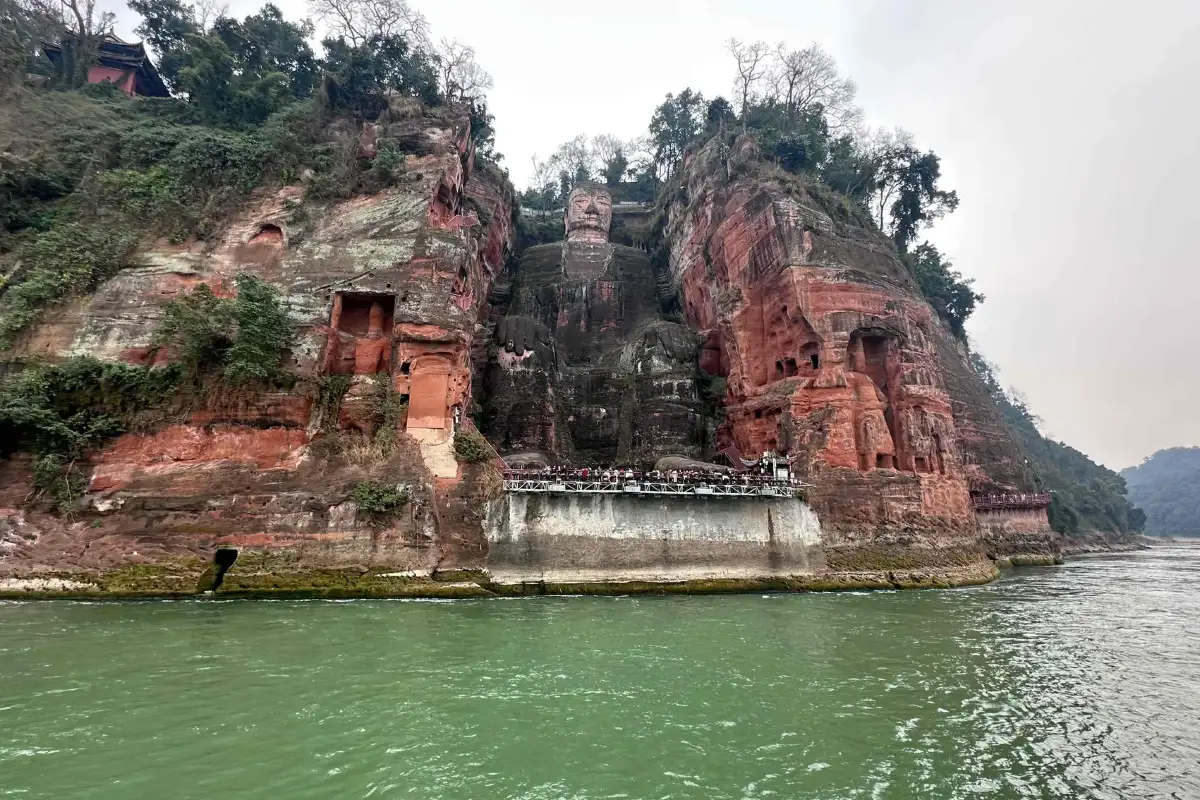











Everyone recognises the postcard: a giant stone Buddha gazing serenely over three rivers in Sichuan. Fewer people know the stranger truths behind it — a monk who supposedly blinded himself to prove his devotion, more than a thousand hair buns hiding an engineering secret, and a second Buddha lying hidden in the mountains themselves. Here are ten facts that will change the way you look at the Leshan Giant Buddha.
🧾 Quick Facts
- 📏 Height: approximately 70–71 metres
- 🛠 Carved 713–803 AD — about 90 years of work
- 🌊 Setting: cliff above the Min, Dadu and Qingyi river confluence
- ⭐ Rated 4.7/5 by 33,000+ travellers on Trip.com
📊 The Ten Facts at a Glance
Before the deep dives, here is the whole story in numbers — every figure below is unpacked in the sections that follow:
| Fact | The number |
|---|---|
| Total height | Approx. 70–71 metres |
| Construction period | 713–803 AD (about 90 years) |
| Hidden hair buns | Around 1,021 |
| People on one instep | 100+ |
| UNESCO twin listing | 1996, together with Mount Emei |
| Traveller rating today | 4.7/5 from 33,000+ Trip.com reviews |
🗿 How Big Is the Buddha, Really?
Size is the first thing nobody is prepared for, and the numbers only half explain it. The rest of the surprise is where the statue stands: at the meeting point of three rivers, carved straight into a working cliff face.
📏 It Is One of the Tallest Pre-Modern Statues on Earth
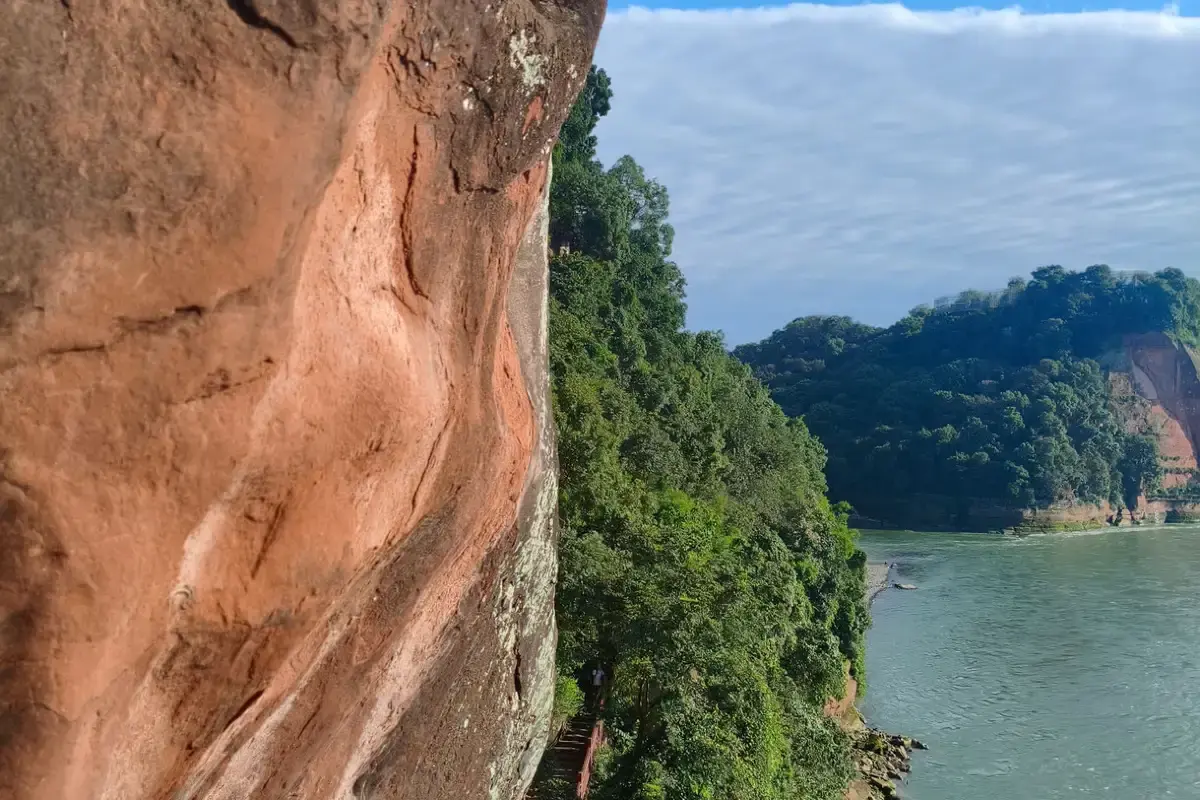
The seated Maitreya stands roughly 70–71 metres from base to topknot, carved directly into the cliff of Lingyun Mountain where the Min, Dadu and Qingyi rivers meet. To feel the scale in human terms: one of its insteps can hold more than a hundred people standing on it, and a single toe is taller than most adults. Photographs flatten it — which is exactly why both the feet platform and the river cruise exist.
⏳ A Project That Outlived Its Founder
Great statues are usually commissioned by emperors; this one was started by a single monk and finished by strangers. The ninety-year story behind it is as moving as the statue itself.
🛠 It Took About 90 Years Across Generations
Work began in 713 AD and finished in 803 AD — roughly ninety years spanning multiple generations of stonemasons, engineers and donors. Construction stalled when funding ran dry and restarted under later officials, so the statue you see today is a relay race completed by people who never met its founder. Few monuments anywhere on Earth were built with that kind of patience.
🧘 Monk Haitong Started It to Calm Deadly Currents
The Buddha was not conceived as art. The confluence of the Min, Dadu and Qingyi rivers was notoriously dangerous, and the monk Haitong of Lingyun Temple believed a carved Maitreya would calm the waters that swallowed boats every year. Legend adds the most famous detail: when officials tried to extort the building funds, Haitong gouged out his own eyes to prove the money was not for himself — and the work continued. His full story deserves a longer read in our Haitong history guide.
📜 The Tang Dynasty Gave It a Formal Name
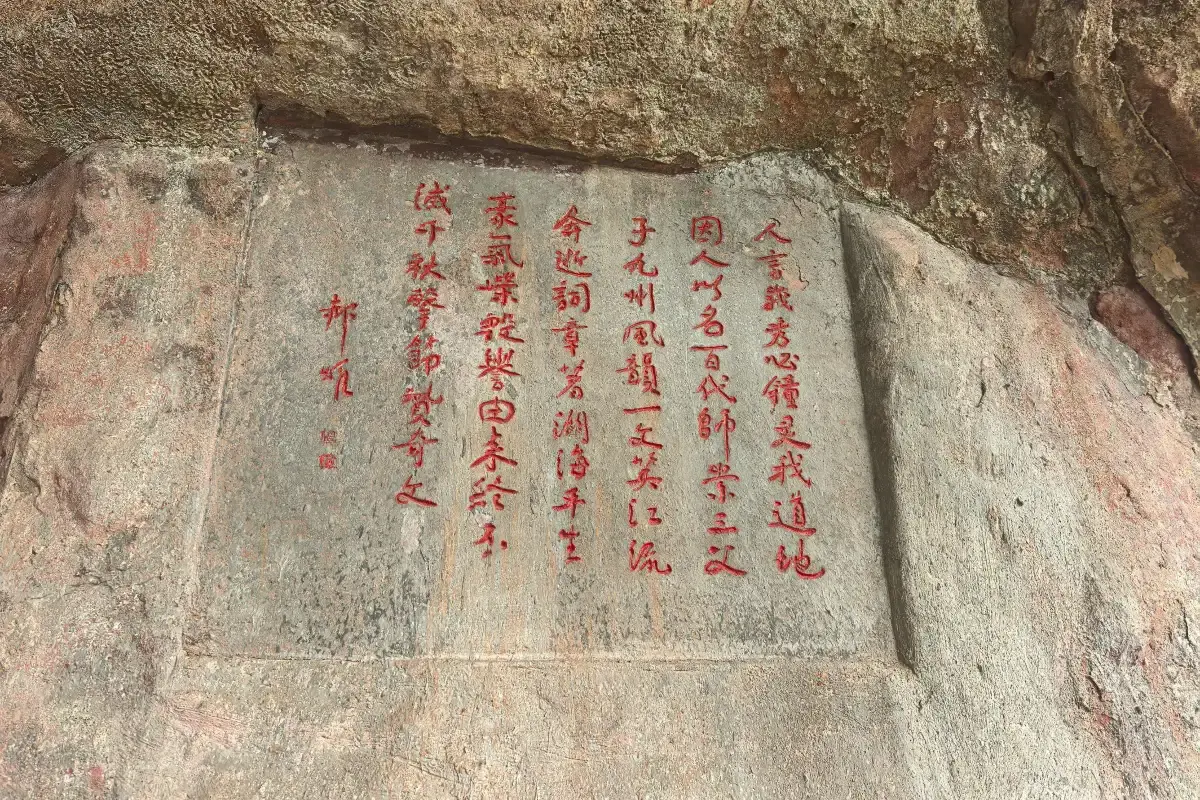
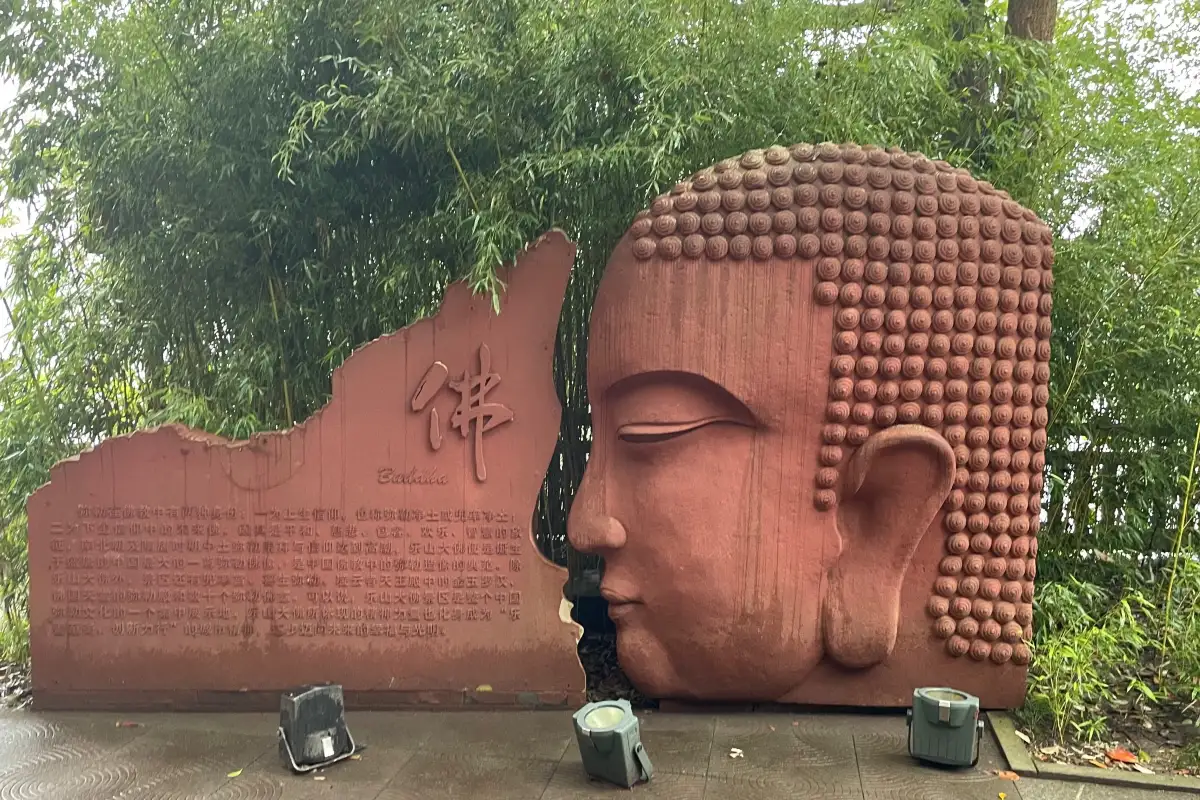
An inscription from the Tang era records the statue’s official title: the “Jiazhou Lingyun Temple Great Maitreya Stone Statue”. That formal name explains much of its identity — it belongs to Lingyun Temple, it depicts Maitreya the future Buddha, and it was carved for spiritual rather than decorative reasons. Today many locals still simply call it the Lingyun Giant Buddha.
🔧 Engineering Secrets Hidden in the Stone
The most impressive thing about the Buddha is not its size but its survival strategy. Tang craftsmen built water management into the statue itself, and it is still doing its job twelve centuries later.
💇 The ~1,021 Hair Buns Are Not Just Decoration
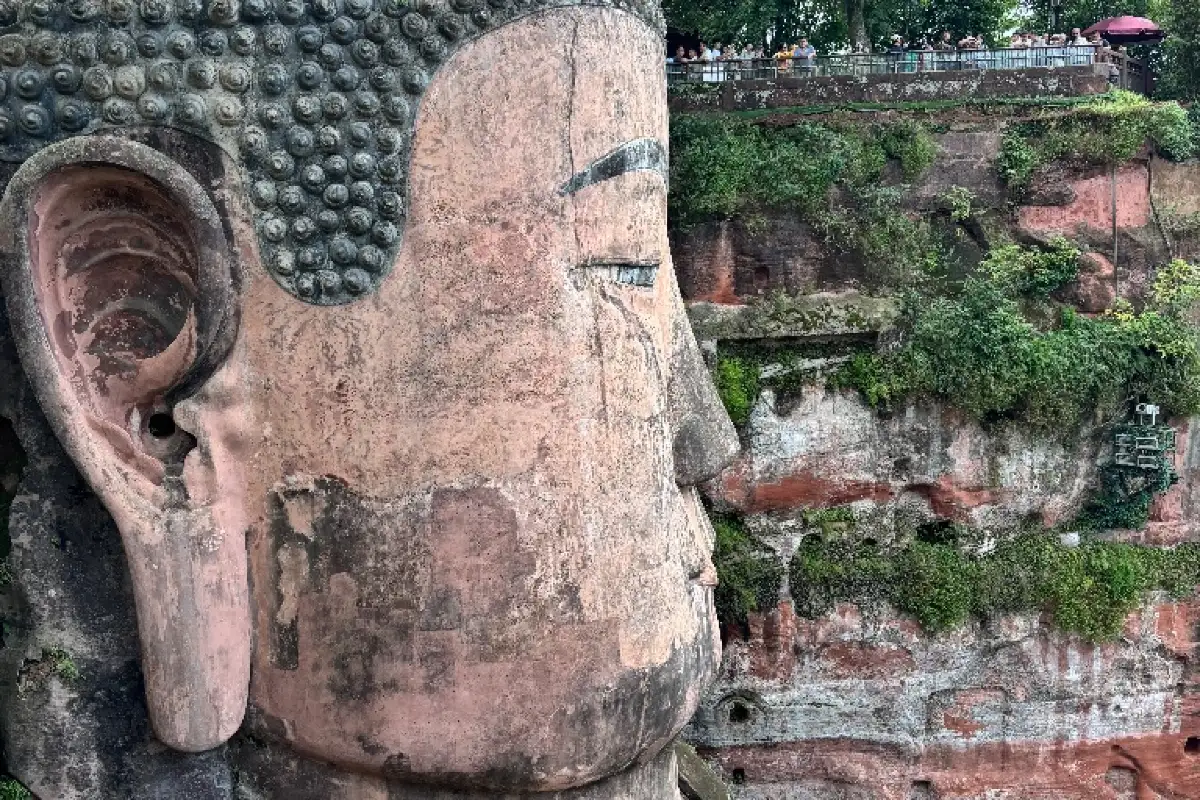
Count the curled buns on the Buddha’s head and you will reach roughly 1,021 — and they are doing structural work. The buns help channel rainwater off the top of the head and away from the face, a clever piece of Tang Dynasty engineering disguised as styling. From the head platform you can see how each row is laid like roof tiles.
💧 A Hidden Drainage System Runs Behind the Ears and Back
The statue’s real defence is invisible from the front: drainage channels carved behind the ears and at the back of the head and body carry rainwater away from the stone surface. This hidden plumbing is a major reason a soft stone carving has survived twelve centuries of monsoon weather. It is the quietest, and arguably cleverest, engineering story at the site.
🪨 Red Sandstone: Easy to Carve, Hard to Preserve
The cliff is red sandstone — soft enough that Tang craftsmen could carve a 71-metre statue with chisels, and soft enough that wind, rain and moss never stop working on it. That is why the statue has undergone restorations across the centuries and why conservation continues today. The weathered patches you notice in photos are the trade-off for the statue existing at all.
🌍 Heritage Status and a Second, Hidden Buddha
Official recognition and local legend meet in this final pair of facts. One put the statue on the world stage; the other hides in plain sight across the water.
🏛 It Shares UNESCO Status with Mount Emei
In 1996, UNESCO inscribed Mount Emei together with the Leshan Giant Buddha as a single World Cultural and Natural Heritage site — a twin listing that treats the sacred mountain and the giant statue as one cultural landscape. For travellers, the pairing makes an ideal two-part trip, since Emei Shan lies within easy reach of Leshan. Few destinations pack a World Heritage mountain and a World Heritage statue into one journey.
🌊 From the River, the Mountains Form a Reclining Buddha
Viewed from the water, the outlines of Wuyou, Lingyun and Guicheng mountains join to form a giant reclining Buddha, with the seated statue sitting exactly at its chest — the famous “Buddha within a Buddha”. The effect is easiest to appreciate on the river cruise, and some travellers find the reclining silhouette even more moving than the statue itself.
🛡 Survival, Earthquakes and Modern Fame
Twelve centuries is a long time for any stone monument, let alone one standing over three rivers. Somehow, this one kept its serenity — and its audience.
🌄 It Has Stood Through 1,200+ Years of History
The statue has outlasted wars, floods, earthquakes and dynasties since its completion in 803 AD, protected partly by its cliff niche and partly by that drainage engineering. Today it is one of China’s most beloved sights, ranked No. 9 among the best things to do in Sichuan and rated 4.7/5 by more than 33,000 travellers on Trip.com. Statues this old rarely grow more popular every year — this one has.
If those facts have you reaching for your calendar, go and meet the details in person: walk down beside the statue on the plank road, or see the statue and its sleeping twin together from the water. The facts stop being trivia the moment you are standing at the toes.
❓ FAQs
Is the Leshan Giant Buddha really 71 metres tall?
Measurements vary slightly by reference, but it stands approximately 70–71 metres — one of the tallest pre-modern statues anywhere on Earth. A single instep holds more than a hundred people.
Why was a Buddha carved on a river cliff?
Safety came first: the three-river confluence was deadly for boats, and monk Haitong believed a carved Maitreya would calm the waters. The statue doubled as a spiritual guardian for the crossing.
How old is the statue?
Carving ran from 713 to 803 AD, so the Buddha is over 1,200 years old — begun in the height of the Tang Dynasty and finished by later generations of masons.
Can you see the reclining Buddha without a boat?
The reclining outline needs distance and elevation, so it is best appreciated from the river. The cruise gives the classic vantage; from the cliff top you are simply too close to read the shape.
Does the Buddha need constant restoration?
The red sandstone is soft and vulnerable, so conservation and periodic restorations have continued for centuries. The hidden drainage system remains the statue’s most important line of defence.
What surprises most visitors is not the size — the photos prepare you for that — but the intelligence behind it: the drainage, the buns, the ninety-year relay of craftsmen. Walk down the Nine Turn Plank Road, explore the Wuyou Temple on the quieter side of the mountain, or take the river cruise to meet the sleeping Buddha. However you do it, the facts will stop being trivia and become the reason the statue is still here.
Ready to See the Giant Buddha?
Tickets start from $11.84 and the scenic area is open 08:00–19:00 (admission ends 17:30).
🎟 Book Tickets on Trip.com 🎫 Check Klook Prices
Affiliate disclosure: as a Trip.com affiliate we may earn a commission when you book through these links — at no extra cost to you.