








Roughly seventy metres tall and carved across ninety years, the Leshan Giant Buddha is one of the most ambitious stone projects of the Tang Dynasty. Its story begins not with art but with fear: the water where three rivers collide was capsizing boats, and a monk decided a Buddha could calm it. This is the history of that idea — the vision, the ninety-year grind, and the engineering that has kept the statue standing for twelve centuries.
🧾 Quick Facts
- 🛕 Work began in 713 AD, led by monk Haitong of Lingyun Temple
- ⏳ Completed roughly ninety years later, around 803
- 📏 Approx. 70–71 m tall — a seated Maitreya
- 🏛️ UNESCO World Heritage since 1996, twin-listed with Mount Emei
- 🕗 Site open 08:00–19:00 (admission ends 17:30)
🌊 The Deadly Confluence That Started It All
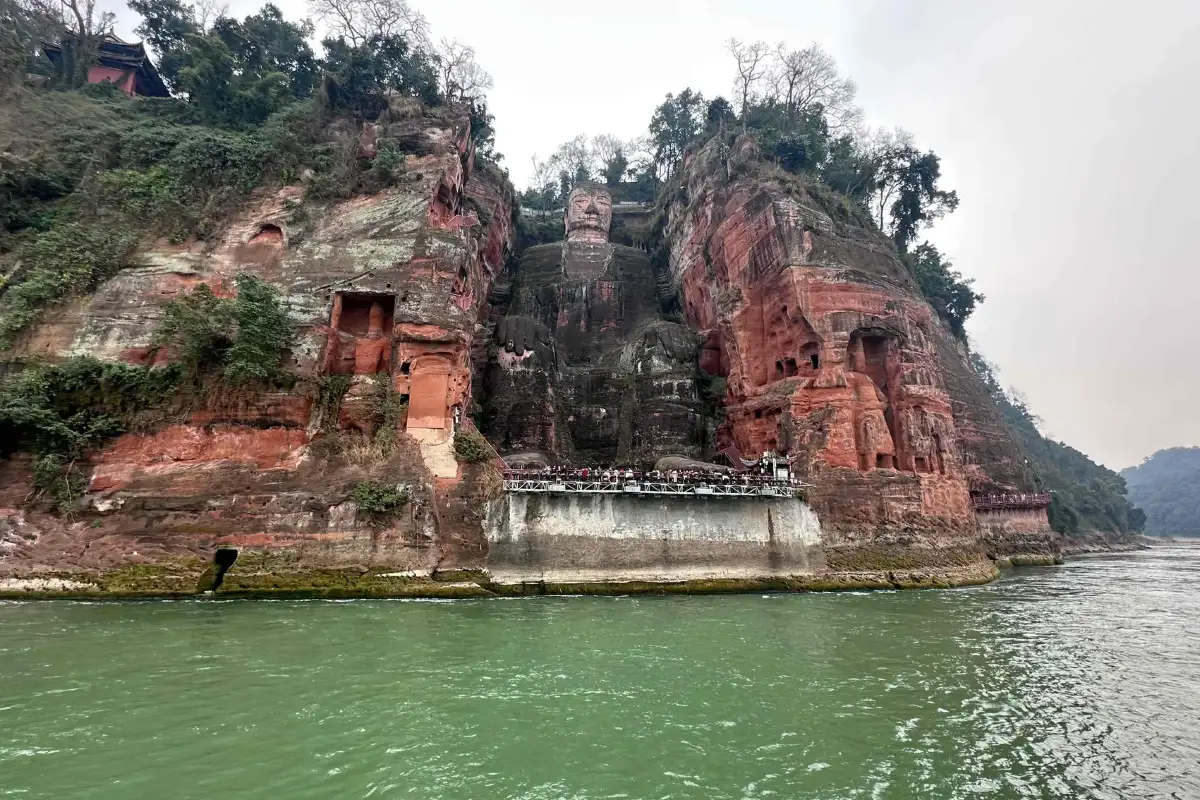
Leshan sits where the Min, Dadu and Qingyi rivers meet below Lingyun Mountain, and in Tang times the collision of those currents made the water treacherous. Boats were swamped and capsized at the confluence, and the danger was simply part of daily life for the traders and pilgrims who passed through. It was here, above the turbulence, that the monks of Lingyun Temple decided something had to be done.
Their response was astonishingly literal. Rather than build a shrine beside the river, they would carve a Buddha into the cliff, vast enough to overawe the water itself. The figure was conceived as Maitreya, the future Buddha, whose serene presence was believed to calm the currents. Faith, in this case, came with a stonemason’s schedule measured in decades.
🧘 Monk Haitong’s Vision of 713
In 713 AD the monk Haitong of Lingyun Temple set the project in motion, raising funds across Sichuan and beyond to pay for a carving on a scale the region had hardly attempted. His argument was practical as well as spiritual: a great Maitreya watching over the confluence would settle the waters and protect the boatmen who risked them. Haitong spent years fundraising and preparing the site, and the first outlines went into the cliff under his direction.
The most famous story about Haitong is exactly that — a story. As the legend goes, a local official demanded the project’s funds, and Haitong gouged out his own eyes to prove the money was sacred and not to be touched; the official, shamed, backed away. However the episode truly unfolded, it explains why Haitong’s name is still spoken with reverence in Leshan. He never saw the statue finished, and devotion of that intensity is precisely why the project survived his death.
⛏️ Ninety Years, Generations of Craftsmen
Work proceeded in waves: energetic beginnings under Haitong, a stall after his death when money and leadership ran out, and a later resumption backed by local officials who understood what the project meant for the region. Carving continued across different reigns of the Tang Dynasty, outlasting the people who started it. Completion came roughly ninety years after the first chisel stroke — around 803, by most accounts — making this a project that grandparents began and grandchildren finished.
| Year or period | What happened |
|---|---|
| Before 713 | Three rivers collide below Lingyun Mountain; boat traffic faces deadly currents |
| 713 | Monk Haitong of Lingyun Temple begins raising funds and carving the Maitreya |
| Mid-project | Work stalls after Haitong’s death, then resumes with official backing |
| Around 803 | Carving completed, roughly ninety years after work began |
| 1996 | UNESCO lists “Mount Emei Scenic Area, including Leshan Giant Buddha” as World Heritage |
🛠️ The Engineering Hidden Inside the Statue
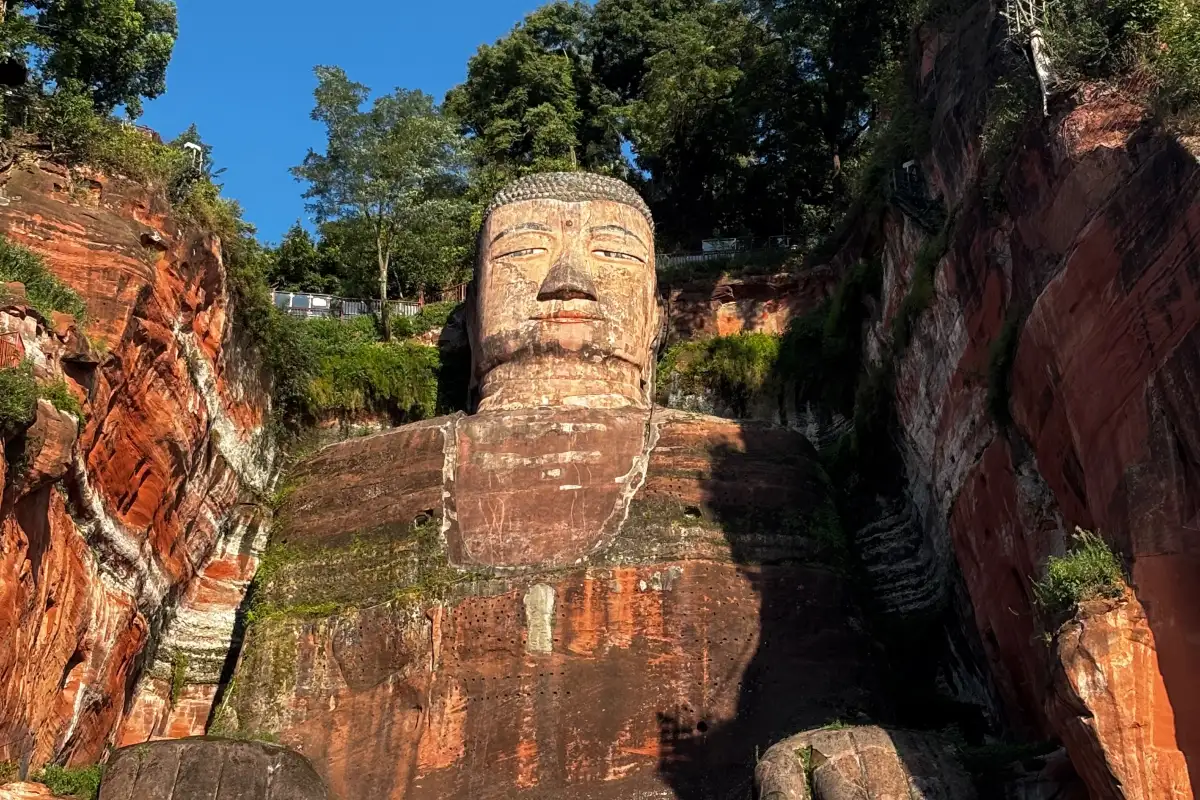
A seventy-metre statue does not survive twelve centuries of Sichuan rain by luck. The carvers built a hidden drainage system into the rock, with channels running behind the ears and through the hair buns to carry rainwater quietly away from the face and body. To a visitor the statue looks like pure sculpture; to an engineer it is also a well-disguised plumbing scheme.
The hair itself is part of the design: around 1,000+ spiral buns, each shaped and fixed individually, double as drainage features and weathering armour. The deep folds of the robe give the surface texture that disperses water, and the red sandstone has proven more durable than it looks. Later restorations have repaired weathering, but the original engineering is the reason there was a statue left to restore.
📜 The Inscription That Reveals the Original Name
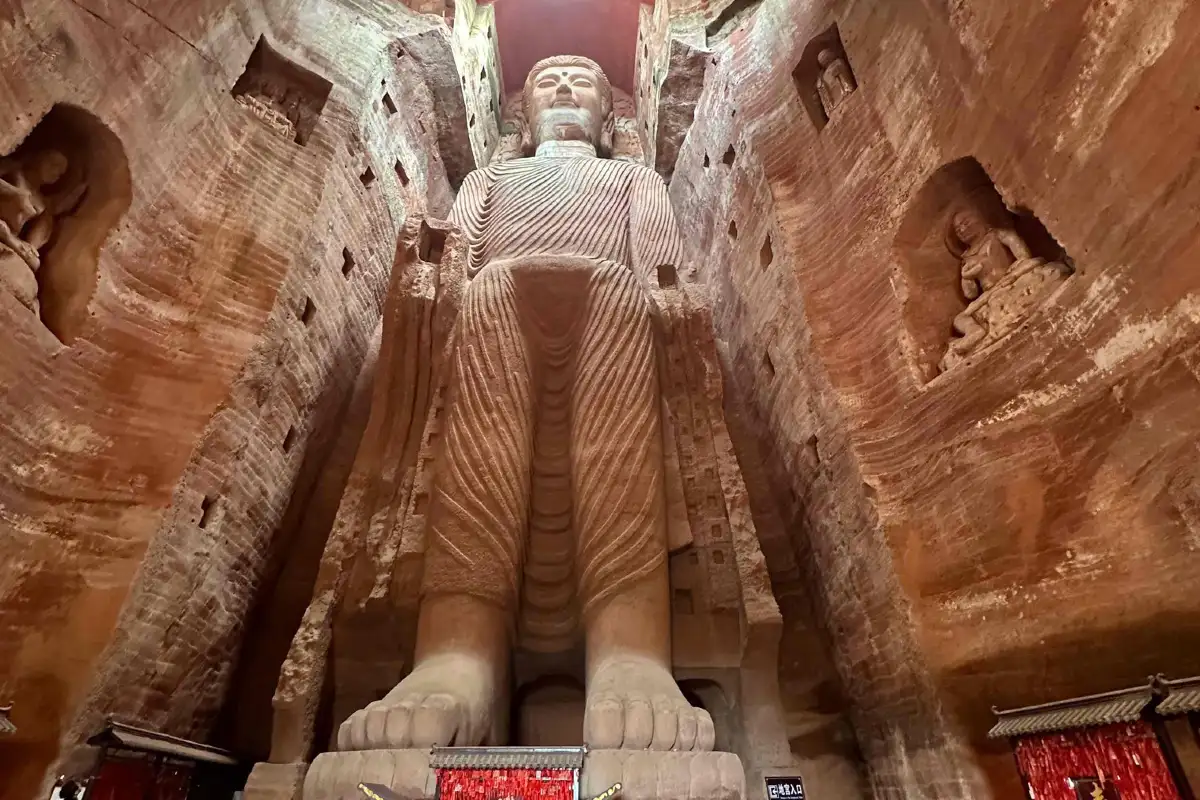
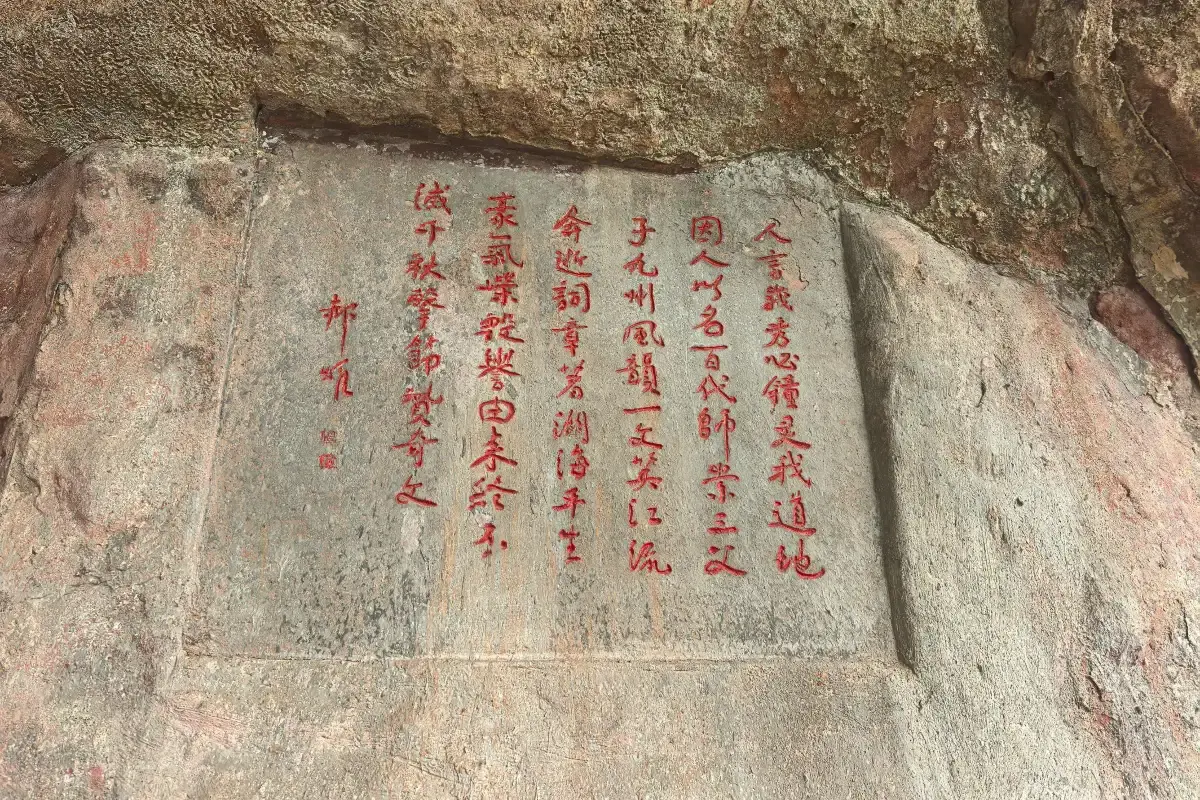
To the right of the Buddha a carved stone inscription from the Tang era still survives, reading “Jiazhou Lingyun Temple Great Maitreya Stone Statue”. It is a builder’s own record, confirming both the statue’s identity and its home at Lingyun Temple — which is why the statue’s formal name is the Lingyun Giant Buddha. Few monuments anywhere come with their founding document carved into the adjacent rock.
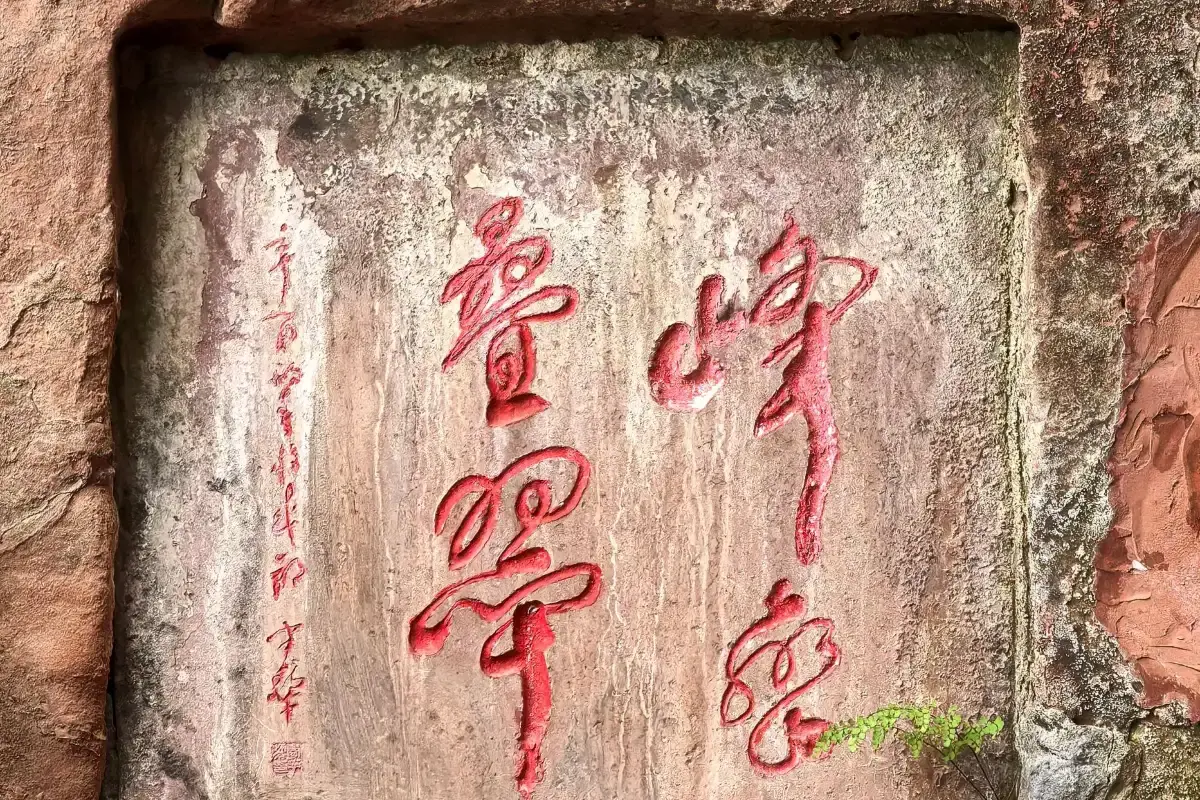
The inscription also settles any doubt about who the statue depicts. The figure is Maitreya, seated in calm authority above the rivers — a point the founding text makes explicit. When a guide tells you the Buddha’s “real” name, this stone is the source they mean.
🏛️ Restoration and the 1996 UNESCO Listing
Centuries of rain, floods and ordinary stone weathering took their toll, and the Buddha has been repaired many times across its long life. Modern conservation has stabilised the cliff, treated surface damage and monitored the drainage that protects it. The work is ongoing, because a statue this size is never truly finished being looked after.
In 1996 UNESCO inscribed “Mount Emei Scenic Area, including Leshan Giant Buddha” on the World Heritage list — a twin listing that recognises the two sites as one cultural and natural landscape. They sit roughly 35–45 km apart, and most travellers now treat them as a single trip. Our two-day twin-heritage itinerary shows how to pair them properly.
⛰️ What “The Mountain Is a Buddha” Really Means
A local saying describes the statue perfectly: the mountain is a Buddha, and the Buddha is a mountain. The carvers did not place a statue on top of the cliff — they removed stone until the cliff itself became a seated figure, which is why the walking routes hug what is effectively his body. When you descend the plank road, you are travelling down the outside of the sculpture itself.
Zoom out and the idea repeats on a grander scale. Seen from the river, the outlines of Wuyou, Lingyun and Guicheng mountains run together into a reclining giant Buddha, with the seated statue resting at its chest — a “Buddha within a Buddha”. The quiet Wuyou side of the site holds much of that story, which we cover in our Wuyou Temple guide, and the monasteries around both mountains are described in our Lingyun and Wuyou temples guide.
❓ FAQs
🕯️ Why was Maitreya chosen?
Maitreya, the future Buddha, was associated with compassion and with soothing the turbulent waters at the confluence. The Tang inscription confirms the statue has always been Maitreya, not a later reinterpretation.
👁️ Did Haitong really gouge out his eyes?
It is a legend rather than documented history, passed down to illustrate his extraordinary dedication. What is documented is that he began the project in 713 and did not live to see it completed.
🗓️ When exactly was the Buddha finished?
Around 803 is the widely accepted date, roughly ninety years after work began in 713. Sources differ by a year or two, which is normal for a project of this age.
⏳ Why did it take ninety years?
Funding collapsed after Haitong’s death, work stalled, and the sheer scale of carving a mountain face with hand tools made the timeline inevitable. Resumption under official backing carried the project to completion.
🗿 Can visitors still see the Tang inscription?
Yes — it survives carved into the rock to the right of the statue. For more background numbers and figures, our Leshan Giant Buddha facts guide pulls them together.
History is why the Leshan Giant Buddha feels different from other famous statues: it was not commissioned to impress anyone but to protect everyone on the river below. Knowing the ninety-year story changes what you see — every hair bun and robe fold is a decision made by craftsmen whose names are lost. Read the inscription, look up, and the old line about the mountain becoming a Buddha stops being a slogan.
Ready to See the Giant Buddha?
Tickets start from $11.84 and the scenic area is open 08:00–19:00 (admission ends 17:30).
🎟 Book Tickets on Trip.com 🎫 Check Klook Prices
Affiliate disclosure: as a Trip.com affiliate we may earn a commission when you book through these links — at no extra cost to you.