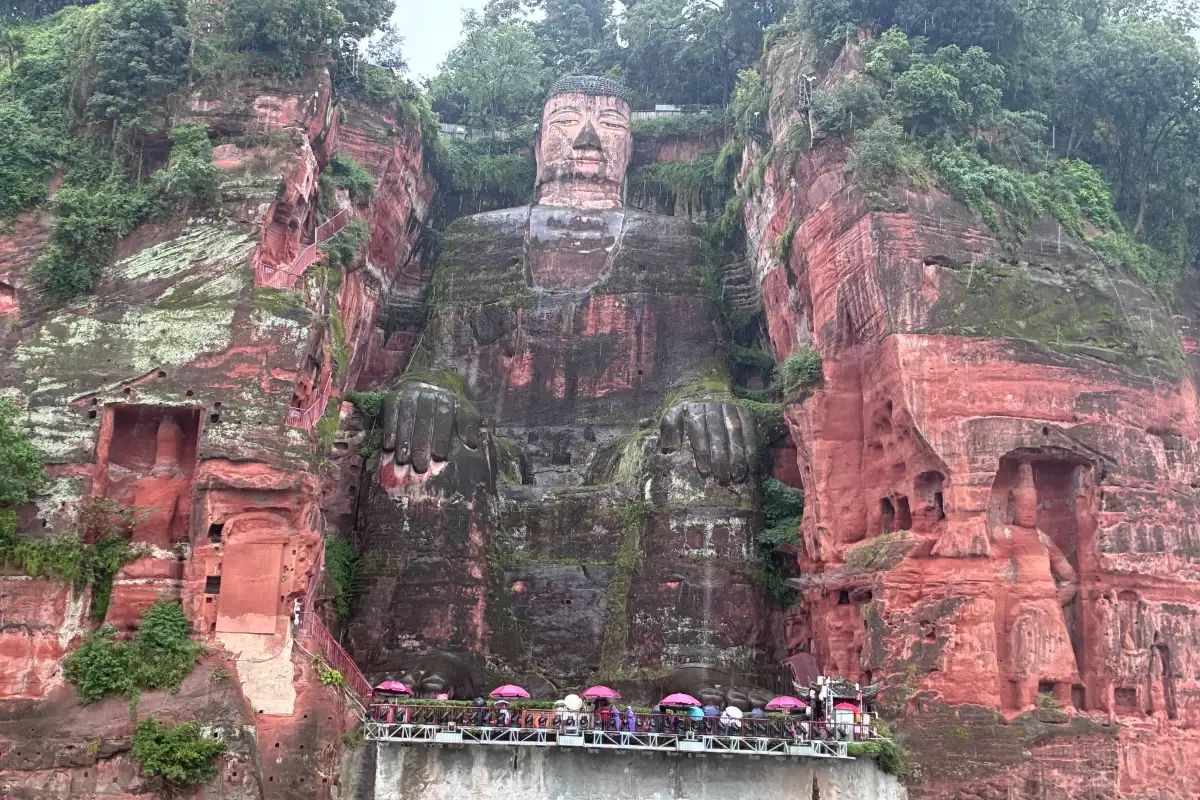










The Leshan Giant Buddha and Mount Emei share a single line on the UNESCO World Heritage list — “Mount Emei Scenic Area, including Leshan Giant Buddha” — yet many international visitors see only one of them. In two well-sequenced days you can stand at the Buddha’s feet and watch morning light hit a mountain-top statue, without ever feeling rushed. Here is the plan, the logistics and the honest trade-offs.
🧾 Quick Facts
- 🏛️ One UNESCO inscription covers both sites (listed 1996)
- 📏 The sites sit roughly 35–45 km apart
- 🚗 Emei railway station to the Buddha: around 40–50 min by car
- 🎟 Buddha entry from $11.84 (standard ticket around 80 yuan)
- 🕗 Buddha open 08:00–19:00 (admission ends 17:30)
🏔️ Why Do Both? One Inscription, Two Worlds
UNESCO did not pair these sites by accident. The twin 1996 listing recognises a single cultural and natural landscape: a Tang Dynasty stone colossus watching over a river confluence, and a forested holy mountain of monasteries rising toward a gilded summit. Together they tell one story of Buddhism in Sichuan — at river level and at cloud level.
The Buddha is regularly ranked among Sichuan’s essential sights — it sits at No. 9 on Trip.com’s Best Things to Do in Sichuan — while Mount Emei is the landscape that made the region a Buddhist heartland in the first place. Seeing only half of the inscription is a bit like reading half a book. If you have two days in the region, resist the urge to choose.
🗺️ The Logistics, Honestly Told
The two sites are roughly 35–45 km apart, and the geography matters: the Buddha sits near river level by the confluence, while Emei is a mountain whose headline sights — monasteries, monkey zones and the Golden Summit — sit far above the plain. High-speed trains link Chengdu with both Leshan and Emeishan stations, and Emei railway station is about 40–50 minutes by car from the Buddha. Day-tripping one after the other from Chengdu is possible; sleeping between them is better.
Choose your night-one base by personality: stay near the Buddha in Leshan for an early, unhurried start, or push to the Baoguo Temple area at Emeishan to wake up already on the mountain. For real options near the statue, our hotels near the Leshan Giant Buddha guide shortlists stays across budgets.
| Day | Base | Highlights | Pace |
|---|---|---|---|
| Day 1 | Leshan, near the Buddha | Head platform, plank road, the feet, Wuyou or river cruise, food street dinner | Full-on |
| Day 2 | Emeishan, Baoguo Temple area | Baoguo Temple, cable car to the Golden Summit, monkey zones | Long day |
| Day 3, if you have it | Your pick | Slow temples, mid-mountain trails, a second cruise | Relaxed |
🗓️ Day 1 — Leshan, the Compressed Version
Run the classic plan: arrive before 09:00 with tickets bought ahead, see Lingyun Temple and the head platform, take the plank-road descent while the queue is young, stand at the feet, then cross to Wuyou Mountain or save the late-afternoon cruise. Dinner belongs on Zhanggongqiao Food Street, because a Sichuan day should end with bobo chicken. The full hour-by-hour version lives in our Leshan one-day itinerary, which this compressed version deliberately follows.
Sleep in Leshan and you start day two thirty minutes from the Buddha; move to Emeishan tonight and you wake up already on the mountain. Either works, and the choice mostly comes down to whether you would rather save morning minutes or evening energy. Just do not try to add the Golden Summit to day one — the summit deserves daylight you will not have after a full Leshan morning.
⛰️ Day 2 — Mount Emei for the Time-Poor
🛕 Morning: Baoguo Temple
Start at Baoguo Temple, the gateway monastery at the mountain’s foot, where incense, red halls and a steep green backdrop set the tone for the day. It is a working temple, so move with the rhythm of the place rather than against it. Confirm bus and cable-car operating times the same morning, because they shift with seasons and weather, and a clear sky is your cue to head for the summit without delay.
🚡 Midday: The Classic Golden Summit Experience
The standard route combines a mountain bus with a cable car up to the Golden Summit, where a gilded statue overlooks cliff-edge terraces at around 3,000 metres. On a clear day you get the famous sea of clouds; in mist you get an atmospheric whiteout, which is why checking the forecast before committing the hours matters. Summit entrance and cable car tickets are extra — check current prices and frequencies on site — and bring warm layers even in summer, because the summit runs far cooler than Leshan. Descend with a margin too: summit weather can delay the cable cars, and you will want buffer before any evening train.
🐒 Late Afternoon: The Monkeys
Emei’s macaques are famous, bold and entirely unbothered by your itinerary. Keep bags zipped, food out of sight and bottles held inside a pack, and give the troop more space than you think you need. Photograph them from a respectful distance and the encounter becomes a highlight instead of an incident.
🔁 When to Invert the Order
Do Emei first if you arrive in Leshan late in the day and cannot beat the morning plank-road queue anyway, or if the forecast gives you exactly one clear day — the Golden Summit in cloud is a wasted journey, while the Buddha forgives an afternoon visit, especially after 15:30 when the crowds thin. It also works in reverse: summer weekends bring their own crowds to the Buddha, so a poor-weather summit day swapped for a weekday Leshan afternoon is often the best trade available. Let weather outrank habit when you decide which site gets the good day.
🎒 Packing for Two Altitudes
Day one is riverside Sichuan: warm, humid, occasionally sticky. Day two rises to a summit where even summer mornings bite, so pack layers you can add at altitude and shed back at the base — a light fleece, a rain shell, and grippy shoes that will serve both the plank road and mountain trails. Our what-to-pack guide covers the full checklist, and the best-time-to-visit guide helps you pick a season that flatters both sites.
➕ Got a Third Day? Upgrade the Trip
With three days, slow down: add the Oriental Buddha Park and a proper Wuyou Temple stroll in Leshan, or give Mount Emei’s mid-mountain trails and monasteries a relaxed day instead of a summit sprint. Even a slower morning — Wuyou courtyards before the drive — softens the pace. The twin-heritage format rewards depth far more than it rewards box-ticking.
❓ FAQs
🗓️ Can it be done as one very long day trip?
Technically possible, honestly miserable. One site per day is the sane minimum, because at both sites the queues, cable cars and walking add up faster than you expect.
🚄 How do I travel between the two sites?
By car, around 40–50 minutes between Emei railway station and the Buddha; by train, short hops connect Leshan and Emeishan stations on the high-speed line. Taxis and ride-hail fill the gaps.
🏨 Which base is better for night one?
Leshan puts you beside the Buddha for an early start; the Baoguo Temple area puts you on the mountain at dawn. Pick by whether day two begins with the summit.
🎫 Do I need separate tickets for each site?
Yes — the Buddha’s entry starts from $11.84 (standard around 80 yuan), while Mount Emei charges its own entrance, with cable car tickets extra. Check current prices before travelling, and keep e-tickets handy for both.
☁️ Is the Golden Summit worth it in cloud?
Only partially — the view is the point of the summit. If the forecast is poor, swap your days and give the mountain your one clear morning; the Buddha is happy in almost any weather.
Two days, one inscription: the Buddha at the river and the mountain above the clouds belong together, and this itinerary lets them make sense in sequence. Book the Leshan night early, watch the weather for your Golden Summit window, and let the last evening end with food street noodles rather than a panic-driven train. That is how the twin-heritage trip is supposed to feel.
Ready to See the Giant Buddha?
Tickets start from $11.84 and the scenic area is open 08:00–19:00 (admission ends 17:30).
🎟 Book Tickets on Trip.com 🎫 Check Klook Prices
Affiliate disclosure: as a Trip.com affiliate we may earn a commission when you book through these links — at no extra cost to you.